Profiles
Privateer Type: Counter Cartel authorized via a notional Cartel Marque and Reprisal Act
Privateering Firm: Patriot Strategies Group
Target: Cartels identified by a notional draft Letter of Marque and Reprisal Act
Operating Area: Global
Legal Enablers:
- Performance Incentive Contracting Model subsidized by fines and seizures
- Privateering firms providing enhanced enforcement options paid based on the value of seized assets, or the benchmark value of seized commodities, federal agencies act as force multipliers alongside law enforcement
- Privateering firms provide intelligence support through a Qui Tam-like process with private investigative authorities acting as realtors.
Estimated Prize Value:
Based on low-end estimates of manufacturing costs in the source country and/or an agreed-upon percentage of commercial assets.
Prize Liquidation method: Based off the pre-agreed value of assets seized by cartels.
- Cash, property, cryptocurrency, oil etc.
- Smuggled firearms that can be resold to approved markets.
- A small percentage of the value of narcotics to make it an economically viable option.

Risk and Mitigations:
| Evidence challenged in court (chain of custody, sensor integrity). | Tamper-evident logging, redundant sensors, third-party forensic validation. |
| Perception of private actors performing law enforcement. | Pairing Privateer firms with law enforcement units to provide legal justification, guidance, and force augmentation. Creating a Privateer Certification process. |
| Escalation or diplomatic incident if operations cross boundaries. | Clear geofencing, international coordination, legal review, adherence to State consent, or focusing on counter-cartel operations in the United States. |
| Inconsistency of revenue for the privateering firm. | Counter Cartel privateering firms could spin out of larger security and investigative firms to complement already existing revenue. Smaller privateering firms could specialize in niche targets or geographies. |
Narrative Introduction: The e-mails came in a steady trickle into Carlo’s inbox. The subjects read like an inventory sheet from a hidden war: Request Contraband for Condemnation: 345 pounds of cocaine. Auction of Forfeited Cartel Asset: Real Estate Property, 3483 1st St. Condemnation Process: 10,000 rounds of ammunition. And on they went.
Patriot Strategies Group LLC’s opening for an “asset manager” had sounded mundane enough when Carlo first applied, except for the salary, which was nearly 50% higher than comparable jobs in the area. He had imagined some boutique investment office handling distressed properties or obscure venture capital portfolios. Instead, he discovered Patriot Strategies Group was something entirely different.
The founders’ biographies were not decorated with Ivy League schools or Fortune 500 firms, but with an alphabet soup of agencies: HSI, DEA, DHS, CBP, ATF. Most of the leadership had spent decades investigating narcotics trafficking, sanctions evasion, smuggling networks, and organized crime before transitioning into the private sector after the passage of the expanded Cartel Marque and Reprisal Authorization Act of 2025. What had begun as a limited pilot program authorizing private-sector support for cartel asset identification had quietly evolved into an entire ecosystem of contractors supporting federal interdiction and forfeiture efforts.
Patriot Strategies Group had started small. At first, the company merely provided analysts and technical contractors equipped with AI-assisted cargo screening tools, forensic accounting software, crypto tracing platforms, and surveillance systems to assist federal investigations. Embedded contractors worked alongside CBP officers at major ports of entry, helping flag suspicious cargo, shell company imports, hidden cash movements, and vehicles tied to cartel networks. The company’s software cross-referenced commercial and select government data in seconds, tipping and queuing teams to identify contraband and identifying other nefarious individuals.
When seizures occurred, Patriot Strategies Group received a contractual percentage of recovered assets under federally approved incentive agreements established by the pilot authorities under the Cartel Marque and Reprisal Authorization Act.
Over time, the business evolved from being a cheap force multiplier for the government. Now the company-maintained databases containing hundreds of prospective cartel-linked targets: trucking firms, warehouses, cash businesses, ranches, cryptocurrency wallets, luxury homes, and commercial fronts spread across the Southwest and beyond.
The commodity valuation tables on Carlo’s monitor resembled something from an investment bank, except every line item represented contraband. DEA guidance established baseline values for narcotics. ATF tables provided standardized prices for firearms, ammunition, and modified drones. Treasury and OFAC data helped estimate the value of frozen accounts, sanctioned commodities, and seized property.
Every seizure had a valuation attached to it. Every valuation is translated into percentages. Every percentage translates into revenue for both Patriot Strategies Group and the government.
Most of Carlo’s work revolved around the investigatory division. Analysts built intelligence packages on suspected cartel assets using customs anomalies, financial records, social media analysis, and informant reporting. Patriot Strategies Group personnel never conducted arrests or raids themselves that remained strictly within government authority, but they assembled targeting packages, managed evidence organization, coordinated technical support, and handled post-seizure asset processing.
One file crossing Carlo’s desk that morning involved a chain of seemingly ordinary auto repair shops stretching across southern Texas. Individually, they looked legitimate. Together, they formed part of a laundering network tied to fentanyl trafficking and firearms procurement. Attached to the report were spreadsheets of suspicious wire transfers, border-crossing data, drone photos of late-night cargo transfers, and flagged customs manifests linked to shell import companies.
Projected recoverable assets: $12.4 million.
Carlo leaned back in his chair and looked across the office floor where former agents, accountants, analysts, and data specialists worked beneath glowing maps and financial dashboards. Some had once hunted cartel networks for the government. Now they did similar work under corporate logos and performance incentive contracts born from what politicians had publicly described as “counter-cartel augmentation authorities.”
Patriot Strategies Group executives never used the word privateer. Publicly, they described themselves as a “national security support and strategic asset recovery firm.” It sounded cleaner that way.
But late at night, after enough drinks, some of the founders would joke.
“The old letters of marque were blunt instruments,” the retired HSI supervisor had told him once. “Now they come with oversight committees, performance metrics, and quarterly reviews.”
Privateer Type: Traditional Privateers falling underneath a federal Privateer Center
Privateering Firm: Patriot Privateers LLP
Privateer: Wes Johnson
Position: Partner/Crew Member
Target: Rare Earth Shipping
Operating Area: Mozambique Channel
Legal Enablers:
- Letter of Marque capability delegated to a joint federal center supporting 50 authorities titled 10 or title.
- Performance incentive contract with services tied to successful criminal, administrative, and civil seizures.
- Letter of Marque capability delegated to a joint federal center
Estimated Prize Value: 1 billion -2 billion varies based on the size of the ship, the amount, and the type of rare earth ore
Prize Liquidation method: Based on the auctioned value of the ships according to U.S prize law, or based on a pre-agreed value provided by a federal center before boarding.
Risk and Mitigations:
| Generation of space debris endangering other satellites (chain of custody, sensor integrity). | Collateral damage estimates and mediation recommendations to be approved by a government representative |
| Perception of private actors performing law enforcement. | Public messaging |
| Uncertainty regarding adjudication of prizes and ROI for privateers | A Federal Privateer Center to provide benchmarking and prior approval for interdiction operations. |
| Escalation or diplomatic incident if operations cross boundaries. | Clear geofencing, international coordination, legal coordination |
| Privateers are not recognized as having rights under the Laws of Armed Conflict. | Public messaging that privateers are lawful combatants and deserving of all rights and consideration under the Geneva Convention. |
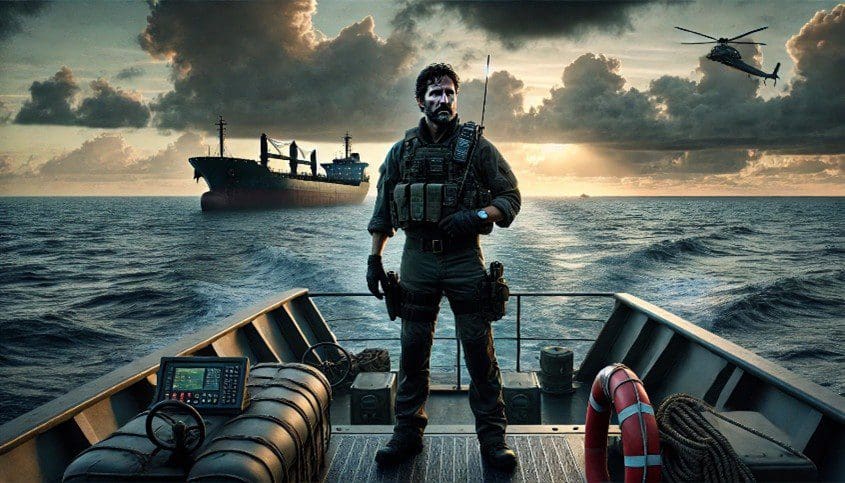
Narrative Introduction: The blip on the monitor finally dipped out of the exclusive economic zone of Mozambique and Madagascar, and the Captain of the modified salvage ship, the Armstrong Wes Johnson, checked the chat from the United States Privateer Center or USPC. ARMSTRONG TO BOARD OBO27 AND DELIVER TO PRIZE COURT3, HOUSTON, TEXAS. AUTHORIZED TO USE LETHAL FORCE TO SECURE VESSEL. THREAT: SUSPECTED PRIVATE MILITARY CONTRACTORS WITH LIGHT WEAPONS. PRIZE PAYOUT 800 MILLION US DOLLARS. Wes repeated the message over the intercom, and a feeling of excitement gripped the ship. The RHIB crews started preparing the boats and their gear. The drone operator began preparing the custom quadcopter, inspecting its ordnance, and Wes steered the Armstrong on course toward their assigned prize.
Wes’s firm, Elite Maritime Training LLP, or EMT, had been primarily involved in maritime training for law enforcement. The firm had eagerly applied for and received an Indefinite Delivery/Indefinite Quality (IDIQ) contract from the United States Navy, under which it would perform maritime seizures in the event of armed conflict with the United States, with the caveat that contractors would be awarded a portion of the value of cargo successfully auctioned. The firm recognized it for what it was: a notice to receive a Letter of Marque. That IDIQ contract had been executed one week ago with the simultaneous attack of a close U.S ally and cyber-attacks launched against the United States, which had plunged swathes of the country into darkness for several hours and resulted in the deaths of Americans.
Wes, a partner in EMT, had eagerly received their orders from the USPC, along with several other private firms, which were dispatched to various maritime chokepoints around the world. The USPC provided 24/7 indications and warnings, approved targets or prizes, and rules of engagement, which were eagerly studied by the Armstrong's crew, all of whom were retired or former Marines and naval special warfare operators with experience in maritime assault and VBSS (Visit, Board, Search, and Seizure) operations. When the war broke out, many of them wished they had been young enough to be still serving, but the attainment of the letter of marque filled them with pride.
The large ore ship appeared on the horizon. Wes increased speed, closing in. The drone team launched a fixed-wing drone to inspect the ore ship's decks and observed pairs of individuals carrying rifles. The boarding team reviewed the footage and held an impromptu brief, just as they had for so many real and training ops. The drone team brought out two large quadcopters with small arms already mounted and sighted in, and conducted flight checks before launching to surveil the armed men on the deck. The zodiacs launched from the Armstrong, and they cruised towards the distant ship, only getting bigger by the second. Wes spoke to the large boat using the radio.
“Hanian7, your ship and cargo have been declared a lawful prize by the United States. Muster your crew on the bridge and await further instructions from the boarding crew. Resistance will be met with deadly force.” Wes received his response from the drone screens on the bridge, with the gun crews now bringing out cases of what looked like ammunition. The zodiacs would soon be in range of these weapons.
“This is your last chance, recall your crew to the bridge, or they will be met with deadly force, abandon all arms where they lie.” Wes delivered the last warning. He saw the gun crews listen to a message over the intercom, but they continued to prepare their weapons. Wes switched to his internal communications to deliver a message to the drone team.
“Fire a burst at the gun crew if they maintain their position, eliminate them.”
“Copy, wilco.” The lead drone team member responded, and a burst of gunfire from the drones startled the embarked security team as they prepared their firing position, but they continued their hurried preparations.
“We are entering the weapon engagement zone of the OBO27.” The lead for the boarding crew came over the internal communication systems.
“Roger,” Wes said before switching to the drone team.
“Waste them, they had their last warning,” Wes said. He was disappointed that it had come to this, but he knew the ROE would allow for that; this was war after all. The drone screens showed strafe runs on the multiple firing positions for the embarked security team on the OBO27; some of the gunmen were killed, some abandoned their position to run into the ship, and others outright surrendered. The rest would be up to the boarding team. The Zodiac closed on the port side of the OBO27 using grappling hooks to attach a rope ladder, and the boarding team was all onboard in a matter of minutes. An hour later, they had swept the ship and gathered the crew on the bridge.
“OBO27 is secured, crew is cooperative, and setting a course towards Houston… we have taken our first prize.” The boarding team communicated over the radio, and the bridge of the Armstrong erupted into a cheers. Wes smiled; his firm had taken over a billion dollars of assets from the enemy, and they would be delivering it to friendly markets, providing a boost to the economy, one that would be eagerly awaited by the United States industrial base, which had finally begun to scale and shift into a war economy.
“First the shipping, then the regime.” Wes thought to himself.
Privateering Firm: Prize Crews, LLC
Privateer: Randy Lee
Position: Prize Captain
Target: Very Large Crude Carrier
Operating Area: Andaman Sea
Legal Enablers:
- Prize Law Title 10 Chapter 883, subtitle C, Part IV §8871. Payment of costs and expenses from the prize fund to enable actors such as prize crews.
Estimated Prize Value: 1.35 million based on 5 percent of the total assessed prize value
Prize Liquidation method: Based on the pre-agreed value of seized contraband, including narcotics.
Risk and Mitigations:
| Evidence challenged in court (chain of custody, sensor integrity). | Tamper-evident logging, redundant sensors, third-party forensic validation. |
| Prize crews not considered to have rights under the Laws of Armed Conflict. | Prize crews handle the transport of prizes outside of conflict areas where adversaries could reclaim prizes and would benefit from the protection of other state assets. |
Narrative Introduction: Randy Lee sat in the galley of the USS Kid. He watched the news about the conflict, the missile strikes on the government buildings and hospitals, the island seizures, and the intense conflict happening on the shores of Taiwan. Sitting in the galley with the sailors felt surreal to him, as he was now directly involved in this conflict, but in a tiny way.
Until two weeks ago, Randy had thought that his sailing days were behind him; his days of piloting massive tankers and containers had been familiar but fading as he played golf and spent time getting to know his grandkids. A visit from a friend had persuaded him to serve as a prize master, one of the first in centuries.
Randy had flown for 24 hours straight before landing in Australia and boarding an SH-60 Seahawk to the Kidd for the second time with other members of his prize crew. The crew had been a hastily assembled, mostly retired, like himself, although the security team was notably younger; most of them were former correction officers or security guards tasked with maintaining their safety and the detention of the crew of whatever vessel the sailors of the USS Kidd had interdicted. The galley or ship’s cafeteria was serving spaghetti and meatballs with lima beans, salads, and the option of a chicken breast. If that was not good enough, there were always little containers of JIF peanut butter and bread—standard fare for any of the United States galleys. Many of Randy’s crew grabbed a bit of sleep face down on the tables or attempted to lie on the large duffel bags filled with provisions and equipment to last the prize crew until their ultimate destination.
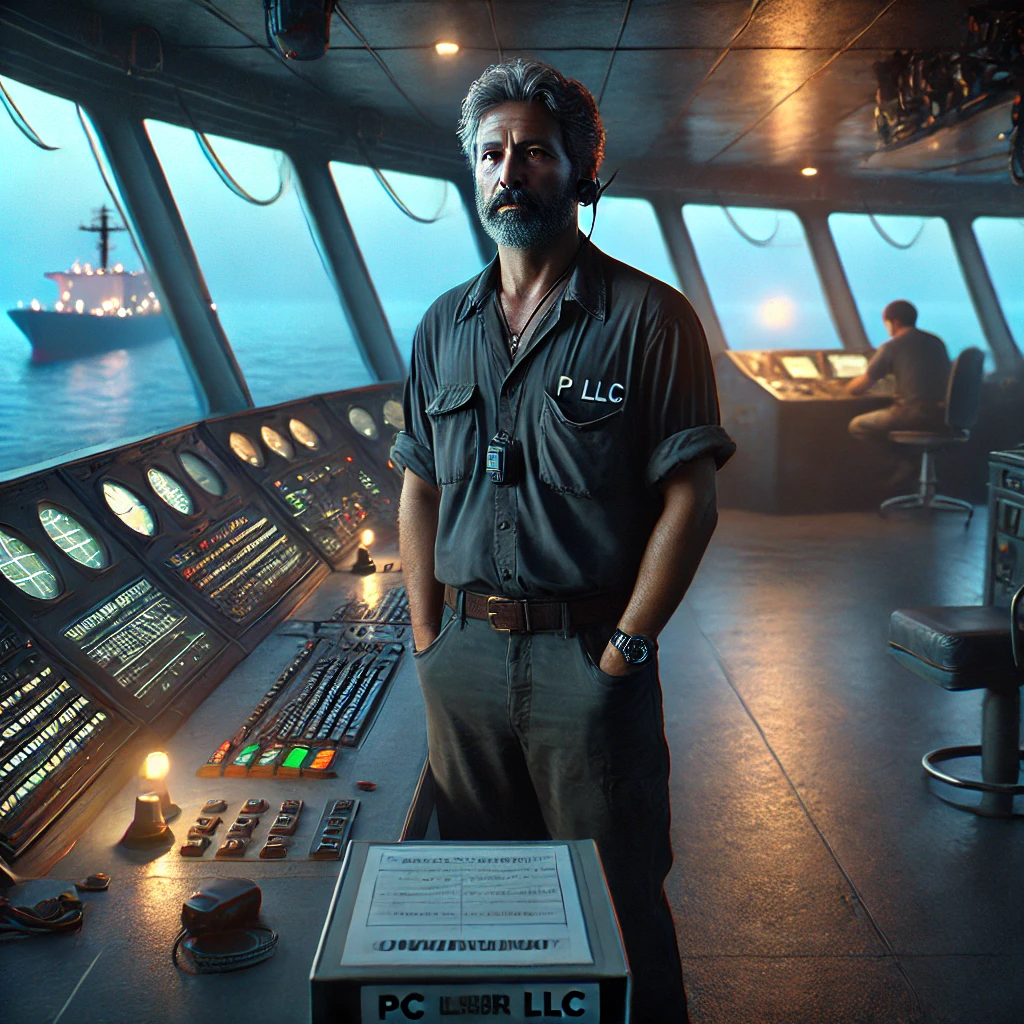
“PC LLC, report to the quarterdeck.” A voice came over the intercom, and Randy made sure everyone was roused and following him before he took his share of the large duffel bags and began to navigate his way through the numbered passageways and hatches of the USS Kid. An old Chief met them at the quarter deck, distinguished only by the gold anchors on the collar of his coveralls, which were stained with sweat and smelled of diesel.
“We are ready to start taking you to the prize, but we will only be able to take four of you at a time with your gear.” The Chief was already walking through another hatch towards the flight deck at the aft of the ship. Randy pointed out his security team: John, his chief engineer, Mike, and another member.
“We will go first, the rest of you be ready when it comes back,” Randy said to the rest of his crew. After taking off from the SH-60, it did not take long before the large merchant tanker could be seen bobbing in the waves next to a zodiac RHIB. The crew of the SH-60 took out the rope that Randy had just learned how to slide down by loosening his grip on the rope. Randy went first. The wind created by the helicopter rotors beat down on him as he shot down the rope. He hit the deck and, with a sigh of relief, found that his knees did not give out. He quickly moved out of the way to allow the rest of the crew and their gear to come down the rope as well. A man in full tactical gear and carrying an M4 approached, one of the SEALS that had been conducting frequent VBSS missions since the start of the conflict.
“Are you here to take this ship off our hands?” The man asked.
“Yes, can you take us to the bridge, and these two will take custody of the ship’s crew?” Randy motioned to the two security personnel in his crew.” " Right this way," the SEAL said and began walking towards the bridge at the back of the ship.
Randy stepped onto the bridge to see the enemy crew sitting cross-legged on the floor, their hands ziptied together, with two SEALs eyeing them cautiously. One of the SEALS appeared older and more experienced, with a streak of gray shooting through his beard.
“Are you the prize master I have been hearing about?” The older SEAL said.
Randy nodded. “That’s right. Randy Caldwell, PC LLC.” His voice sounded steadier than he felt, and he reached along the duffel bag that carried the turnover binder, which he had spent the last few days reviewing.
“Good. We’ve secured the ship, the engine room is cold, comms are isolated, and we’ve done a preliminary sweep. No booby traps, no damage control surprises, at least none we could find.” The SEAL stepped closer, lowering his voice. “Crew’s nervous. They weren’t expecting to get boarded by the Kidd, and they don’t know what is coming next. Keep ’em calm, do you know where you are going?”
“Darwin and then we will be back,” Randy said.
“Good, we can’t keep taking sailors from the Kidd to operate these forever.” The SEAL said.
John sent the other security member below decks to secure a detention area, just like the last one, while he stepped in front of the enemy crew and began reading his prepared speech, promising the crew humane treatment and comfortable accommodations in Australia when they arrive. Mike was busy checking the ship's condition. A few minutes later, once the rest of the prize crew had landed, John took custody of the enemy crew, Randy and Mike started up the ship's massive engines, and the SEALS had returned to the Kidd on their zodiacs. After all the checks were complete, Randy set a course for Darwin on his second trip this month. PC, LLC’s compensation was handsome, but Randy took great pride in knowing that he was now one of the first prize masters of the 21st century.
Privateering Firm: Nijat Group
Proto-Privateersman: Nijat
Position: Classified
Target: State-owned enterprises, cargo ships, and Maritime Militias
Operating Area: South China Sea
Legal Enablers:
- Title 50 Authorities using incentives and covert command and control to select targets
Estimated Prize Value: Varies based on the strike or the requisitioning of cargo
Prize Liquidation method: Payments made surreptitiously through cryptocurrency, hawala, and sales on the gray market.
Risk and Mitigations:
| Increasing tensions | Using methods to obscure connections between the sponsor and the proxy |
| Collateral damage | Maintaining control via financial incentives that could be cut off or seized. |
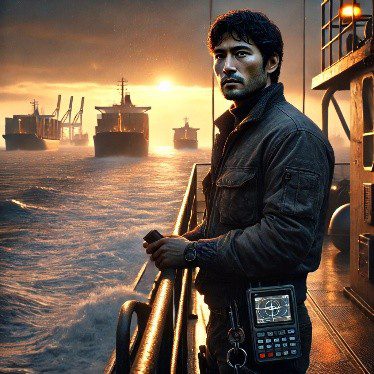
Narrative Introduction: Nijat looked at the sun setting over the waters of the South China Sea, and he paused to wonder whether he had time to pray, not for himself but for his family in East Turkmenistan, who were no longer allowed to pray. It had been years since his family used the last of their wealth to smuggle him out of the internment camps of Xinjiang and into the free world. Still, it was only months ago that he had received the threatening WhatsApp call of a PRC policeman beating his mother and telling him to come back home. It had not been the first, but it had been the last; he knew from the other members of the Uyghur community that it was commonplace, and that the MSS had even gone so far as to use AI-generated videos to deceive them into coming back. Still, Nijat remembered the words of his mother and father, “No matter what we say…don’t come back... If we are broken, you must remain strong.”
Nijat had made his way to the free world and, through some chance encounters, found a way to stop from crying at night and to finally strike back at the evil empire that raped his sisters, enslaved his brothers, and disappeared so many into their “re-education camps”.
Nijat attended school in the West, studying to become an engineer and working at a marina at night to make ends meet. His classmates seemed blind to the persecution happening to his family, while sensitive to whatever popular protest was on campus. He hated them for it, all the “Muslims” and “freedom fighters” who wore the brands that used his people for slavery and could not even admit it. The Muslim world itself had turned its back on its people, selling its oil and prostrating itself to the evil empire.
Then Nijat met Scott, who had reached out from a generic company, Eastern Ventures, or something like that, but it was clear there was more to Scott than met the eye. It was not so much Nijat meeting Scott, but Scott seeing something in Nijat, something beyond the broke, angry college grad, but a fighter. Scott gave Nijat something he did not know he could have, a chance; a chance to strike back at the Chinese Communist Party.
Days later, Nijat was in an intense training program, learning everything from open-ocean navigation to close-quarters combat to piloting one-way attack drones in maritime environments. Nijat would meet his crewmates later, along with other Uyghurs, Hong Kongers, Tibetans, Chinese political expatriates, and even Taiwanese who were sick of waiting for the fight to come to them. Over the course of the pipeline, Nijat had begun to distinguish himself as a leader and soon found himself the leader of a group that used stealth and speed to conduct drone strikes on PRC maritime militia and the disruption of PRC sea lines of communications. Nijat remembered his first operation; piloting a low-profile skimmer while one of his crew, a Tibetan, released a loitering munition into the aft end of a fishing trawler used by the a PRC maritime militia for resupply. Nijat had never felt a rush like the one when he saw the munition detonate, turning off the ship and sending the crew scrambling over the decks. It would take a few hours for the trawler to sink. However, his group was still paid by the shadowy network of beneficiaries that had enabled follow-on operations, extracting sensitive cargo, disrupting PRC operations, and extracting sensitive cargo. Whenever a PLAN vessel or patrol was in the area, Nijat’s group dispersed into the ship traffic and archipelagos of the South China Sea only to strike again.
Nijat’s operations had further increased tensions in the South China Sea. Still, the attacks were blamed on pirates or illegal militia networks defending their waters against illegal fishing operations. The increase in PLAN and PRC military had begun to stretch the PRC, and Nijat thought that it might be time to move on, perhaps to the Western or Eastern Indian Ocean, and continue to disrupt the PRC’s shipping, a small taste of what was to come if the PRC ever chose war.
On this evening in the South China Sea, as the sun’s last orange light caught the wake behind his vessel, he finally knelt not out of fear, but gratitude. He prayed for his crew, for his people, and for the chance to keep taking the fight to the regime that had stolen so much from them.
When he rose, his comms operator handed him a tablet.
“New target,” she said. “High-value. State-owned tanker. Escort light. Orders are authorization-to-disrupt only.”
Nijat nodded, already shifting into mission mode.
“Prep the drones,” he said. “Tonight, we remind them the oppressed still have teeth.”
And as the last daylight faded, the vessel under his command turned toward its next prize.
Privateering Firm: Aquilla Salvage & Security
Proto-Privateersman: Mostapha al-Sayed
Position: Salvage Asset Forfeiture Negotiator
Target: Sanctioned Oil vessels
Operating Area: Global
Legal Enablers:
- Performance Incentive Contracting Model subsidized by the sale of sanctioned assets.
- Pilot Program to enable the Department of the Treasury agency direct access to revenue from operations to pay contractors.
- Contract with an international partner to be paid from the proceeds of seized and forfeited sanctioned assets in conjunction with other allied sanctions programs.
- Salvage law to enable the sale of “abandoned” sanctioned assets that may pose a threat to the environment, with a memorandum of understanding that none of the proceeds from salvage operations benefit a sanctioned entity, and providing indemnity to the salvage firm

Estimated Prize Value: 1.5-13 million dollars based on the size of an oil tanker and discounted by 50% to compensate for the government’s share.
Prize Liquidation Method: Disbursement of contracted percentage from the sale of sanctioned assets.
Risk and Mitigations:
| Disputed legal authority to seize/forfeit cargo (flag state, port state, owner challenges). | Operate only under written authority/MOU from sponsor; obtain pre-operation legal opinions (maritime + local counsel); include arbitration/forum clauses and escrow for disputed proceeds |
| Violating sanctions or mistakenly dealing with sanctioned persons/entities. | Mandatory automated + manual sanctions & BOI screening; retained sanctions counsel for high-value cases; contractual warranties and indemnities from counterparties. |
| Diplomatic incidents or escalation in sensitive/contested waters (Indian Ocean chokepoints). | Strict geofencing, sponsor diplomatic coordination, letters of consent/de-confliction, real-time legal review before operations, and robust public affairs and messaging in support of operations. |
| Inconsistency or delay of revenue stream from prize adjudication and liquidation. | Clear contractual formulas, escrowed proceeds, pre-arranged auction/disposal partners, and operating reserves for legal delays. |
| Armed resistance, violent retaliation, or criminal interference during operations. | Embarked accredited law-enforcement or military advisors for high-risk boardings, defined ROE compliant with sponsor law, threat assessments, and naval escort coordination. |
Narrative Introduction: Mostapha sipped on his tea at 3 AM and looked out from his balcony on Palm Jumeirah, the city of Dubai, an oasis of light amidst the darkness of the sea. His laptop screen displayed nearby blips and a live chat for tracking the transfer. The chat had been set up between a contracted ship with a Department of Treasury Agent and the captain of the crude oil tanker, Sanchi, which was sanctioned for its sponsorship and support of terrorism. Mostapha smiled as he saw the message.
“Transfer complete.” The Treasury agent and the contracted crew had taken control of the Sanchi, with its crew now boarding the salvage ship. In the eyes of the United States Treasury, the Sanchi and its hundreds of thousands of barrels of crude oil were now under the jurisdiction of the United States Department of the Treasury, with the disposition of the ship and cargo to be determined by Aquilla Salvage and Securities LLP, with the approval of the Department of the Treasury, of course.
When Mostapha had gotten his Law Degree, he had not expected that he would be working on facilitating the surrender, forfeiture, sale, and transfer of multi-million dollar assets connected to terrorist organizations or despot regimes. He gave up the fancy D.C. office and the predictable career with well-known firms for Aquilla’s Salvage and Securities LLP, a firm that did not dabble in salvage or securities. His day-to-day varied greatly, including meeting with potential buyers, advising acquisition teams, and attending international task forces to share Aquill’s expertise in facilitating transfer seizures and liquidating sanctioned assets in line with multiple sanctioned programs, with frequent travel between continents.
Mostapha reviewed Aquilla’s Compensation for Actualized Transferred Cargo and Haul (CATCH) contract. The CATCH contract for the Sanchi had been secured months ago when Mostapha and his team had made contact with the Captain of the Sanchi and facilitated turning it over to the Department of Treasury, had Department of Treasury approved buyer for the oil shipment and for the Sanchi at a ship breaking yard in India and had facilitated compensation and relocation packages for the captain and select members of the Sanchi’s crew. Following the turnover and liquidation of the Sanchi Aquilla, it would be awarded a substantial portion of the sale proceeds, with the rest going to Treasury.
As Mostapha understood it, Treasury would then credit the money to lawsuits pending against the Iranian Revolutionary Guard Corps, but that did not matter to Mostapha. Some news agencies labeled these CATCH contracts as escalatory, aggressive, imperialistic, or even piratical, but Mostapha saw it differently. As a student of international relations and the son of Lebanese immigrants, these CATCH contracts were a natural and long-overdue step, taking away billions of dollars from the groups that had displaced his family and killed so many without remorse.
Mostapha smiled to himself as he opened his calendar, an endless patchwork of meetings and tasks, detailing cases in various stages and his various business trips. All of these cases meant tens of millions of dollars for the firm, much of which was reinvested in hiring more acquisition teams and lawyers, including himself. Mostapha smiled. He enjoyed his status with the airlines and hotels, and his paycheck, which would only grow in the near future, but there was something else. He felt like he had become something more than a jet-setting paper pusher, something far grander and older… a privateer.
Privateering Firm: Seasight LLC
Privateerswoman: Dana Santos
Position: Watch Coordinator
Target: Illegal and Unregulated Fishing in United States Waters
Operating Area: Coastguard District 1 off of New England.
Legal Enablers:
- Performance Incentive Contracting Model subsidized by fines and seizures.
- Pilot Program to enable awarding agency access to revenue from operations to pay contractors.
- Embedded Law Enforcement Officers

Estimated Prize Value: from estimated $1,000s in share of fines or millions of dollars for seizing large commercial fishing trawlers. Varies based on whether the catch is seized or if the trawler is seized, forfeited, and auctioned.
Prize Liquidation method: Performance Incentive Contracting via federal or state governments/ profit sharing based on seizures or levied fines
Risk and Mitigations:
| Evidence challenged in court (chain of custody, sensor integrity). | Tamper-evident logging, redundant sensors, third-party forensic validation. |
| Perception of private actors performing law enforcement. | Strict contractual language and public messaging clarifying non-kinetic role; MOU with coastguard. |
| Escalation or diplomatic incident if operations cross boundaries. | Clear geofencing, international coordination, legal review, and adherence to State consent. |
| Inconsistency of revenue for the firm. | Baseline payment for the firm or using unmanned sensors to provide data to other government or private customers, acquire grants from environmental agencies and NGOs |
Narrative Introduction: Dana Santos sat at her computer monitors as she watched the cluster of 17 dots that represented a fishing fleet turn off its AIS, close the line that represented the United States Exclusive Economic Zone or EEZ.
“Game time.” She said aloud to the other people on the watch floor, whose faces, like hers, were illuminated by the blue light of the monitors in a dark room in Plymouth, Massachusetts.
“How far are our assets?” She asked, already knowing that her company, Seasight, already had one unmanned Surface Vessel or USV trailing the fleet of trawlers.
“Squid7 already has visual, and we can see them starting to lower the nets into the water.” One of the watch standers said as an image showed up on the big screen, showing a city of fishing trawlers beginning a flurry of activity.
Dana noted the latitude and longitude coordinates at the bottom of the screen and confirmed in her system that the fleet was indeed within the United States Exclusive Economic Zone by at least a mile.
“Payday.” She said to herself and began issuing orders to the watch standers to check sensor calibration times for squid7 and recheck her work, as well as that of the past shifts. One last check with the organic AI chatbot corrected a few typos, and she sent it to the U.S. Coast Guard District 1 and the National Oceanic and Atmospheric Administration (NOAA). The emails and text messages were followed up with calls. Before long, a Coast Guard cutter and a private vessel with an embarked NOAA law enforcement officer were en route to intercept the fishing trawlers, carrying evidence in hand.
It would take a few days for the government to go through forfeiture proceedings. Still, Dana and the firm she worked for, Seasight, already had money earmarked for performing their identification duties.
Seasight was expanding internationally to the Indian Ocean and the Gulf of Guinea. The company had already begun hiring aggressively and had offered Dana a position in an overseas location. This tropical paradise would provide her with a break from the Massachusetts winters. She was still considering taking a position on one of the interdiction assets to smell the salt air, like many of the fishermen in her family. Still, there was something about seeing the whole picture on a watch floor, and it would probably give her more time to appreciate the beach, she thought.
Privateering Firm: Pacific Marine Enforcement & Training (PMTS) INC.
Privateersman: Ship Boarding Specialist (SBS) Elias Reyes
Position: Mission Commander
Target: Illegal, Unreported, and Unregulated fishing vessels employing forced labor
Operating Area: Eastern Indian Ocean, Philippine Archipelago, South China Sea
Legal Enablers:
- Performance Incentive Contracting Model subsidized by fines, forfeitures,
- International agreements and Memorandums with foreign governments
Estimated Prize Value: Based on pre-agreed valuation of seized catch, vessel forfeitures, and fines imposed for labor and fisheries violations; supplementary revenue through contracted logistics and auxiliary services
Prize Liquidation Method: Disbursement of contracted percentage from fines/forfeitures by host governments; logistical services billed separately at agreed rates
Risk and Mitigations:
| Evidence of labor abuses or IUU activity challenged in court (chain of custody, witness reliability). | Use tamper-evident digital logging, third-party forensic validation, trauma-informed interviews with survivors, and independent NGO observers. |
| Perception of private actors overstepping into sovereign law-enforcement functions. | All interdictions conducted with embarked coast guard or authorized liaison officers; firm limited to rescue and referral, not prosecution. |
| Escalation or diplomatic incident in contested waters (e.g., South China Sea). | Strict geofencing, real-time legal review, international coordination, and operations only under explicit host-state consent. |
| Inconsistency of revenue stream from interdictions. | Establish baseline retainer payments for standby availability, pursue NGO/environmental agency grants, and expand auxiliary contracts (logistics, training, domain awareness). |
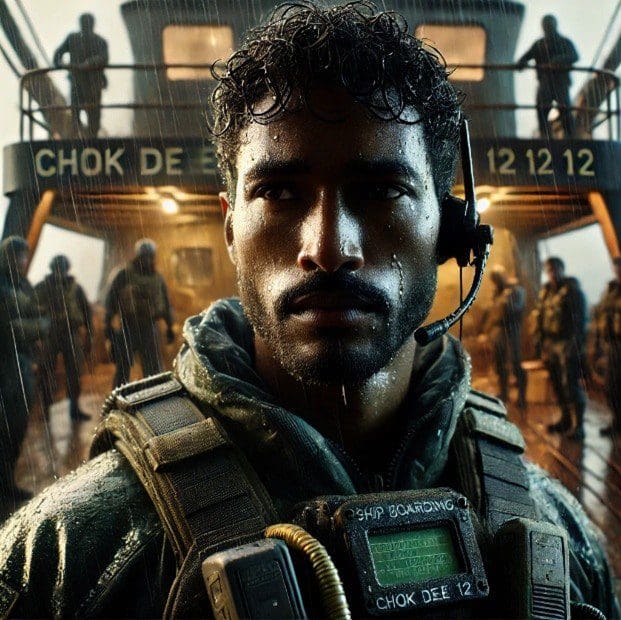
Narrative Introduction: Ship Boarding Specialist Elias Reyes watched on the bridge as “Sea Lion 7” a heavily refurbished and refit fishing trawler came in view of the squalid fishing trawler “Chok Dee 12”. The vessel reeked of neglect, rust streaked down her sides, nets tangled in heaps, and oily bilge water shimmered at the waterline. Even at a distance, Reyes could see gaunt figures moving on deck, their motions stiff and hesitant, as if uncertain whether to flee or collapse. Nattaya Chansiri of the Asian Anti-Trafficking Alliance (AATA) consulted a binder that contained an old photo of the fishing trawler, as if it were taken when it was first built. Nattaya confirmed with the Thai law enforcement officer onboard, who concurred with Nattaya that the Chok Dee 12 was the Sonkla 3, a vessel connected to a notorious human trafficking network, and the disappearance of young Thai and Burmese men and boys suspected to be enslaved on the vessel.
Months of lobbying and delicate deconfliction finally paid off. A memorandum of understanding among AATA, the Thai government, and the Filipino government cleared the way for the Chok Dee 12 to be declared stateless. Soon after, Manila granted permission for the Pacific Marine Enforcement & Training (PMTS) to transport a Thai law enforcement officer on board the vessel to investigate the human trafficking reports.
A short time later, The Sea Lion 7’s Rigid Hull Inflatable Boat (RHIB) splashed down, carrying the VBSS crew across the choppy water. A sullen man with sharp features, later identified as the captain, stood at the rail with folded arms, eyes burning with defiance.
Reyes and two seasoned PMET operators climbed the ladder first. The smell hit immediately: sweat, diesel, and decay. The deck was littered with broken buckets, makeshift bedding, and scraps of spoiled fish. Huddled near the stern were six men, their skin marred by untreated cuts and fresh and old bruises. They seemed confused by the men in tactical gear, but their faces bore a look that said it could not get any worse.
“Six of the missing persons were identified,” came the report.
But the joy was short-lived as Nattaya began interviewing some of the trafficking victims away from the stern look of the captain, she learned of the countless crew who had died due to the hazardous conditions, and those unable or wiling to work were outright killed by the captain and their corpses tossed overboard.
On deck, the Thai officer confronted the captain. The man sneered, saying nothing, but his silence was damning.
Reyes looked back at the rescued men, trembling but breathing. The victory was partial, with lives saved, but others were confirmed lost to the sea. He felt the weight of both as he radioed in:
“Command, this is Reyes. Boarding complete. Six survivors recovered. Evidence of homicide onboard. Request immediate custody transfer to Thai authorities. This vessel is secured.”
As the Sea Lion 7 prepared to tow the Chok Dee 12 toward port, Nattaya closed her binder slowly, staring at the trawler’s nameplate. “Sonkla 3,” she whispered. “May it never sail again.”
Privateering Firm: American Gulf Interdictions (AGI) LLP
Privateersman: Dan “Knots” Mercer
Position: Captain
Target: Smuggling in the Gulf of America
Operating Area: Gulf of America
Legal Enablers:
- Performance Incentive Contracting Model subsidized by fines and seizures
- Embedded law enforcement officers from the Drug Enforcement Agency, Department of Homeland Security
Estimated Prize Value: Based oon50% of the cost of manufacturing the narcotic in the source country.
Prize Liquidation method: Based on the pre-agreed value of seized contraband, including narcotics.
Risk and Mitigations:
| Evidence challenged in court (chain of custody, sensor integrity). | Tamper-evident logging, redundant sensors, third-party forensic validation. |
| Perception of private actors performing law enforcement. | Embarked law enforcement provides legal justification and guidance. |
| Escalation or diplomatic incident if operations cross boundaries. | Clear geofencing, international coordination, legal review, and adherence to State consent. |
| Revenue volatility for the privateering firm. | Baseline payment for firm or using unmanned sensors to provide data to other government or private customers, acquire grants from environmental agencies and NGOs |
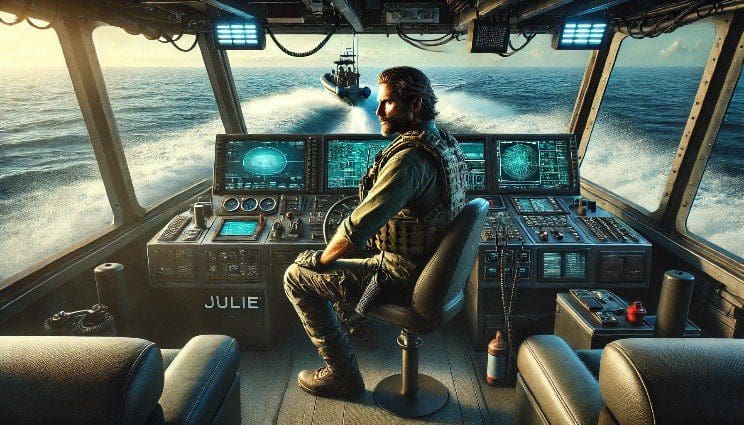
Narrative Introduction: The powerful outboard motors roared, propelling the custom-built craft through the relatively calm waters of the Gulf of America. The radars had detected the incoming craft one hour ago, and Dan “Knots” Mercer, his crew, and the embarked DEA Agent Jones were now speeding in that direction. It did not take long to find out why Knots was Dan’s call sign. He maneuvered the waters at high speeds, taking inputs of the target that their watch floor now assessed had come from a Mexican port notorious for its smuggling of heroin, cocaine, and fentanyl into the United States. This would be his fourth this month if he could catch them. The last three had resulted in 500 kilos each, and the current incentive of 500 dollars per kilo had brought in over 1.1 million dollars to their firm. Just one prize or interdiction like that and they could pay off the boat, which had been named “Julie”. The “Julie” was named after his navigator and business partner, Tom’s niece, who had been poisoned by fentanyl that was carelessly discarded near a playground. To Tom, this venture was more than profit; it was about something deeply personal and preventing the death of future innocents.
The “Julie”, which had been the most significant part of the startup costs for American Gulf Interdictions (AGI) LLP. After that, every interdiction would be pure profit, and based on current trends, Knots expected to take home around $40,000 per successful interdiction, or $500 per kilogram. It seemed like a lot of money until one realized that a kilo of heroin or cocaine was worth thousands of dollars on the street and rising. AGI’s startup costs were less than one million, while a Coast Guard cutter cost more than 110 million; by comparison, the government had quite the bargain with AGI.
Julie’s crew had earned their expertise through decades of experience with Naval Special Boat teams and the Coast Guard, and had tested it through certification to be attached to the task force as Modern Authorized Revenues from Qualified Underwriting of Enforcement, or MARQUE for short. Before long, the dot on the horizon became clearer to reveal a speedboat speeding across the blue waters of the Gulf. As the distance between the boats closed, Agent Jones looked through the optical camera, which was now recording, and saw that the boat was filled with white bales and powered by two outboard engines. The crew of the drug boat had just now noticed the craft gaining on them. One of the drug smugglers stepped towards one of the bales but was stopped by another drug runner who screamed and gestured as if to say no more. Monitor the drug boat as it continues over the din of its engines. As the “Julie” closed in, one of the drug runners produced a rifle and let off several shots, still too far to be effective, something that would have waved off other firms, but the Julie was one of the few that had been certified by the Gulf Task Force for hostile interdictions.
Knots warned his crew over the internal communication system to take cover and to grab their own firearms. One of the other crew members remotely activated a fire hose located at the bow of the “Julie”.
As Julie got closer, one of the remotely activated water hoses let loose a stream of high-powered seawater that struck the armed drug trafficker, sending him backward and his rifle overboard. Then, the stream of water impacted the two outboard motors of the speedboat, flooding and disabling them. The drug runners, realizing their run was up, now attempted to throw the drug bales overboard, but Knots maneuvered alongside the speedboat with his crew, leveling their firearms at close range of the drug traffickers; they swiftly surrendered. Just as they had trained before, Agent Jones and an additional crew of the “Julie” jumped while the remaining crew covered them with their rifles. Jones and the AGI crew member handcuffed the drug traffickers and inspected the rest of the speedboat to make it safe. Tom boarded the speedboat and secured a cable to tow it into Galveston. In Galveston, Agent Jones would take the traffickers into custody, the speed boat would be seized, the drugs would be tested, weighed, destroyed, and the price paid to AGI. From there, Knots and his crew would inspect the “Julie” for damage, repair it if necessary, refuel, and wait for orders from the task force, with a new law enforcement officer ready to intercept the next target.
Privateering Firm: Vayder Venture LLC
Privateer: Ted Hern
Position: Chief Operating Officer
Target: Satellites
Operating Area: Low Earth Orbit
Legal Enablers:
- Letter of Marque capability delegated to a joint federal center supporting title 10 or title 50 authorities.
- Performance incentive contract tied to successful contract requirements
- Letter of Marque capability delegated to a military component

Estimated Prize Value: 2 to 5 million
Prize Liquidation method: A private firm is paid under a contract with the United States for selling freed-up orbital slots to generate revenue from orbital operations.
Risk and Mitigations:
| Generation of space debris endangering other satellites (chain of custody, sensor integrity). | Collateral damage estimates and mediation recommendations to be approved by a government representative |
| Perception of private actors performing law enforcement. | Public messaging |
| Attribution and risk of misidentification. | Coordinating with Allied Space Domain Awareness agencies to positively identify adversary space assets |
| Risk of Escalation | Only utilize orbital privateers in armed conflict and ensure legal can review each target to ensure a defense nexus. |
| Privateers are not considered to have rights under the Laws of Armed Conflict. | Public messaging that privateers are lawful combatants and deserving of all rights and consideration under the Geneva Convention. |
Narrative Introduction: Captain Janet Hopper of the United States Space Force checked in with Ted Hern at his desk in the operations room for Vayder Ventures, still a bit cold from the frigid Colorado winter day.
“Did you get it? You are good for TY19; the collateral damage estimation for the debris removal is acceptable.” She said excitedly.
“Yes, Captain, we are working it now. You can check with Keith for more details; he will be piloting ZOM3.” Ted Hern was the Operating Officer for Vayder Ventures, a joint venture between a leading on-orbit service company and a space domain awareness agency.
For the past few years, Vayder Ventures has been acquiring research cubesats, defunct communication satellites, and ISR satellites. The divesting companies were happy to eliminate the operating costs and liabilities associated with operating these assets in increasingly congested low Earth orbit. Wall Street had assumed that Vayder Ventures was looking to salvage the satellite components more profitably, and to some extent, that was true. Still, the increase in tensions between the global superpowers had provided another opportunity for Vayder Ventures. Vayder Ventures had not only been scrapping these abandoned space assets but also refurbishing, refueling, and equipping them for use in orbital warfare, all within their crowded junkyard thousands of feet above the Earth.
Ted looked at the vast amounts of computing power at the disposal of Vayder Ventures, the massive supercomputers used to calculate debris fields, and the systems that receive, send, and refine tracking, telemetry, and control or TTC data. All of this was necessary to operate successfully in space. Ted ran a diagnostic to ensure everything was running smoothly before he rose from his desk and walked over to the satellite pilot for the show.
OP1 was an old university-owned cubesat designed initially for a remote-sensing mission to analyze environmental effects. Still, it had now been made into what was affectionately known at Vayder as a zombiesat, a refurbished satellite designed to crash into a larger satellite. Vayder Ventures had added a new control unit, a small solar array, a propulsion system, and optics, which would broadcast a first-person view to capture the initial impact of the OP1 with TY19. This enemy ISR satellite provided data that would allow enemy missiles to target United States sailors, marines, soldiers, and airmen.
Ted and Captain Hopper gathered around the desk of Keith Lane, a veteran satellite pilot who still insisted on wearing a flight suit as he typed in new directions for the PV1 to close in on the TY19. Ted would typically have taken the time to ask if Keith was comfortable in his onesie, but there was palpable tension in the air for days. The PV1 had been navigating through debris fields and was now burning fuel to rapidly close on the TY19. Two keystrokes later, the OP1’s camera came on board.
“AI targeting activated,” Keith said as the trio watched with trepidation as the TY19 came into view, the last frame showing the satellite before the link signal was lost across the screen. Hopper, Keith, and Ted cheered as if their team had just won the Super Bowl in overtime.
“Space Command will be pleased with this result. I am sure there will be demand for more work.” Hopper said.
“We look forward to it,” Ted said, already thinking about the following targets he had lined up.
Privateer Type: Intelligence/Civil Privateer
Privateering Firm: Vigilanteers, INC
Privateersman: Stephanie Nelson
Position: Operations Manager
Target: Human Trafficking, Narcotics, Fraud
Operating Area: United States Midwest
Legal Enablers:
-
- Performance incentive contract with services tied to successful criminal, administrative, and civil seizures.
- Embedded law enforcement officers from the Drug Enforcement Agency, Department of Homeland Security
- Qui Tam-esque lawsuits to enable cases against a wider variety of targets, including national security and other felonious activity.

Estimated Prize Value: Based on a portion of recovered revenue, seizures, forfeitures, fees and fines.
Prize Liquidation method: Based off the pre-agreed value of seized contraband to include narcotics.
Risk and Mitigations:
| Evidence challenged in court (chain of custody, sensor integrity). | Tamper-evident logging, redundant sensors, third-party forensic validation. |
| Perception of private actors performing law enforcement. | Embedded law enforcement provides legal justification and guidance. |
| Escalation or diplomatic incident if operations cross boundaries. | Clear geofencing, international coordination, legal review, and adherence to State consent. |
| Inconsistency of revenue for the privateering firm. | Baseline payment for the firm or using private capital or government grants for initial funding. |
Narrative Introduction: She took a moment to go through the e-mail, reading it over again and comparing it with her handheld notes. Soon her shift would end, and someone else’s would begin at 4 AM. Now that she had made it through the hustle and bustle of talking with every team and compiling it into a highly bulleted e-mail. The Child Protection team had 30 ongoing child enticement investigations, with the digital investigations and physical surveillance tasked with verifying identity of suspected child predators. The narcotics team had identified a number of dealers and their physical locations to tip and cue investigators. Finally, the fraud team was continuing investigations into 56 fraud investigations with national security implications.
Stephanie cc’d the government agent on each situation report for all of the operations before watching the e-mail leave her outbox and she began packing up. These government liaisons made the final decision on when there was enough burden of proof to proceed forward with an arrest, seizure, forfeiture, and subsequent payment to Vigilantes. That was a key point of Stephanie’s job to monitor revenue and to allocate the money to the accounting department who would continue to make sure the teams and the bills would be paid.
That being said, as Stephanie walked past the team rooms, many of the personnel were still hard at work on their work, and others who were showing up for the day shift, the hissing of espresso machines now signaled the incoming relief to the night crew. The teams loved their jobs and the ability to make an impact alongside the police, but of course, the quarterly bonuses went a long way to justifying their jobs to their families.
She giggled at the idea of some of the teams participating in the social media stunts that so-called pedophile hunters used to pull in the years past. Some of these social media star wannabes did it for exposure, sure, but many of them also did it out of frustration with the slow-turning wheels of the government. Vigilanteers and other firms like that had helped to make the police and the attorney general’s job faster and more effective. They would review the packages before either proceeding forward with an arrest, providing recommendations, whether that be finding more information or dropping the case entirely.
Stephanie lingered outside the door and breathed in the crisp, cold morning air, a heavy contrast to her long hour inside. Her iPhone buzzed with the faint ding of an e-mail notification, which she opened up and read.
“Thanks, we will be briefing these to the AG first thing this morning.”
“It’s already morning,” Stephanie thought, relieved that at least the government liaison officers were awake. As she began her workout and later drew the blackout curtains across her apartment, she took comfort in knowing that the wheels of justice would keep turning quietly, steadily greased by the dedication of those still working at Vigilaneers.